Know what your promotions actually did — and what to do next.
Causal baseline → incrementality → elasticity → optimization, chained into six views that end in a concrete action per customer.
Separate real uplift from what would have sold anyway, attribute halo and cannibalization, measure price and volume elasticity, and get an optimizer that recommends the right depth and mechanic per brand and sub-channel — not the deepest discount.
Each page sits one click from the others. The filters you set — date range, channel, sub-channel, region, brand, mechanic — carry across the module so you're always slicing the same base.
Overview
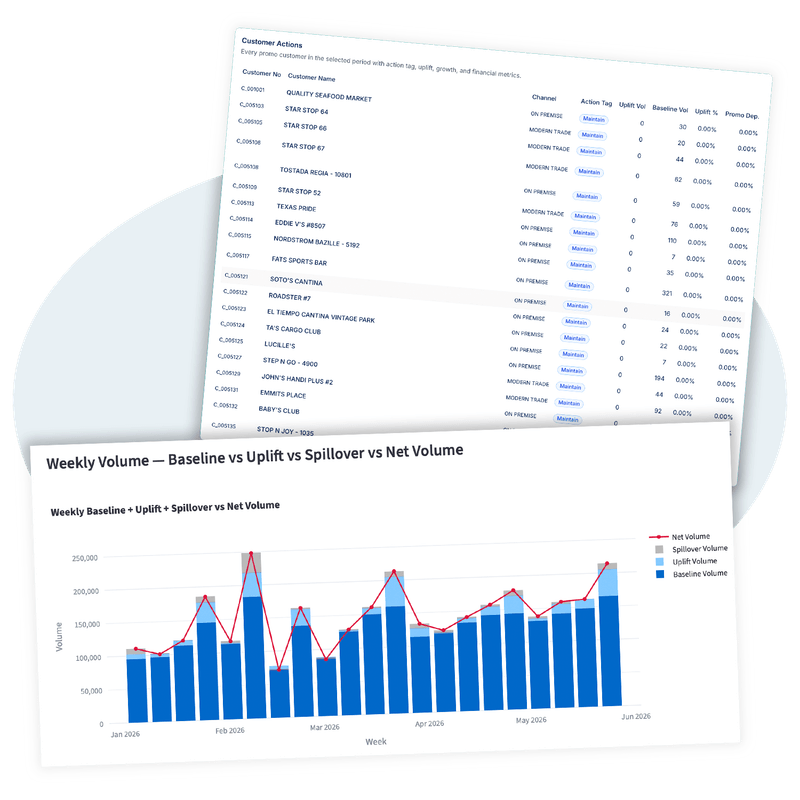
Portfolio KPIs across volume and financials — baseline vs incremental volume, promo spend, incremental revenue and ROI — with a volume-decomposition chart, top brands by uplift, an uplift distribution, and your best optimization opportunities up top.
Incrementality
A five-tab deep dive — Summary, Uplift Analysis, Financials & ROI, Halo & Cannibalization, and Validation — that separates true incremental volume from the baseline that would have sold anyway, and shows the halo and cannibalization each promo creates.
Elasticity
Price and volume elasticity by brand with strength and calibration distributions, built from a dual-level model (SKU signal reconciled with brand × sub-channel), gated by an R² floor so only trustworthy fits ever feed optimization.
Optimization
Scenario simulation across six discount depths with a profit-and-ROI objective, producing an action list, alternative scenarios, and a portfolio-health read — recommending the shallowest profitable depth, never a reflexive deeper cut.
Mechanics
Mechanic rankings (which promo type performs), consumer-mechanic breakdowns, best promo weeks, and a brand × sub-channel heatmap — so the calendar is built on what works, not on what was done last year.
Action List
Non-promo vs promo KPIs per customer with a clear action tag — Stop, Increase, Decrease or Maintain — turning the whole analysis into a single next step per account the field team can act on.
What you'll surface
The questions every trade-marketing and RGM team argues about.
The Promotions module is built around the conversations distributors and CPG manufacturers actually have — not generic BI. Each view is opinionated about the next question, and the filters carry you straight to it.
How much of that promo was truly incremental — and how much would have sold anyway?
Did the promotion create halo, or just cannibalize a sibling SKU?
How price-elastic is each brand, and which fits are trustworthy enough to act on?
What discount depth actually maximizes profit — not just volume?
Which mechanics and weeks deliver the best return for each sub-channel?
For this customer, do we stop, deepen, trim or hold the promotion?
Sales plus a promo calendar. Costs turn on profit ROI.
Map your existing spreadsheets to our canonical schema through the ingestion wizard — column names don't need to match ours. Required sources power baseline, incrementality and elasticity immediately; the cost file turns on profit-based ROI and the optimizer's profit objective.
Source
Description
Required
sales
Sales transactions
Required
promo_calendar
Promotional calendar
Required
customer_master
Customer master
Required
product_master
Product master
Required
cogs
COGS — factory price
Optional
Full schema details on the Data Schema page once you sign in.
Ready to see it on your data?
Request a demo and we'll walk you through the modules with sample data shaped like yours.